

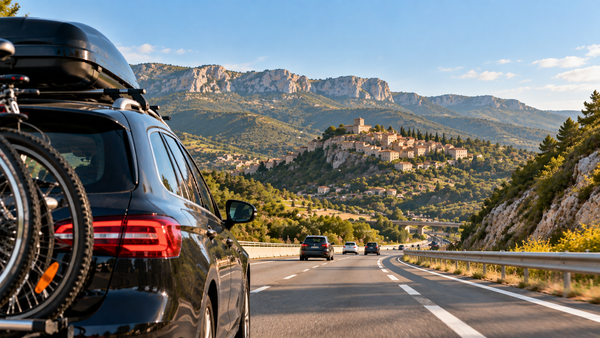
France is the most popular summer holiday destination for Dutch people. It's not surprising, as France is of course relatively close to home and offers something for everyone. From active walking or cycling holidays to city breaks or simply relaxing on the beach.
Regardless of your destination, it's a good idea to pay attention to a few things when travelling to France by car or campervan, or if you plan to hire a car there.
Not 21? Then (usually) no rental car...
Let op: dit gaat over Franse verhuurbedrijven, niet over ons. Hoewel je in Frankrijk vanaf je achttiende een motorvoertuig mag besturen, kun je daar in de meeste gevallen alleen een auto huren als je ten minste 21 jaar oud bent én ten minste één jaar je rijbewijs hebt. Welke leeftijdsgrens bij Adrem in Limburg geldt, is een andere vraag: die vraag je even na bij de balie. Sommige autoverhuurbedrijven hanteren zelfs een hogere leeftijdsgrens. Andere verhuren je graag een auto als je 18 bent, maar door de hoge verzekeringspremie betaal je dan een exorbitant hoge huurprijs.
When you rent a car in France, you will need to present a number of documents, just as you would in the Netherlands. Firstly, a (valid) driving licence and another form of identification, such as your identity card or passport. You will also need a valid credit card to rent a car.
On your way.
When you go out with your (rental) car, you must of course always have your driving licence, proof of insurance (green card) and Take the registration document with you. In addition, the French authorities require you to have a hazard warning triangle, a (fluorescent) safety vest and spare bulbs in your car.
Backup lights are not strictly mandatory, but you must be able to replace a broken light on the spot, which makes it de facto This creates an obligation. On the other hand, it is compulsory to have an alcohol breathalyser in your car. Curiously though, there is no fine for negligence in this case – strange fellows, the French! They also require that if you wear glasses, you keep a spare pair in the car. So if you need glasses but don't wear them, nobody bats an eyelid.
Traffic rules
In France, different traffic rules apply than in the Netherlands, although many rules are the same. For example, in France too, you must ‘simply’ wear your seatbelt (front and back) and it is forbidden to hold your phone in your hand.
When approaching a junction, a traffic sign with a thick vertical line and thin horizontal lines indicates that you have priority, while a sign with diagonal lines means you must give way to traffic from the right.
Op 1 juli 2018 verlaagde Frankrijk de limiet op de National roads and Departmental roads – tweerichtingswegen zonder middenafscheiding – van 90 naar 80 km/u. Sinds begin 2020 mogen de departementen die verlaging zelf weer terugdraaien, en een flink aantal heeft dat gedaan. Het is dus niet langer één regel voor heel Frankrijk: op de ene departementale weg is het 80, een departement verder weer 90. Rijd hier dus op de borden en niet op wat je dacht te weten.
On roads with divided carriageways and two lanes, you can drive at 110 km/h in a regular passenger car or light camper, and 100 km/h in case of precipitation or if you have held your driving licence for less than 3 years. With a caravan attached to your car, you can only drive at 80 km/h on these roads.
On motorways, you can drive at 130 km/h in your car or light camper, or at 110 km/h in rain or if you are a novice driver. Also keep in mind that on the ‘fast’ left lane of motorways, a minimum speed of 80 km/h applies.
In France, you'd better stick to the speed limit. Firstly, of course, for your own safety and that of others. But also because of the many speed cameras on French roads. In France, the use and possession of any equipment that detects speed cameras is forbidden - including on your navigation system!
Toll roads
France has toll roads, with different rates for different vehicles. Cars, vans, and motorhomes normally fall into category 1. A car with a caravan is category 2. Is your motorhome or van taller than 3 metres or heavier than 3500 kg? Then you fall into category 3. You can pay with your credit card at all toll booths, and with cash at most of them. With a so-called toll tag, you can drive through everywhere seamlessly and the toll will be automatically settled.
Ben jij al vaker met de auto of camper in Frankrijk op vakantie geweest? Misschien heb je nog tips die je met onze volgers wilt delen. De regels in dit stuk zijn nagekeken in september 2026.